PQC Needs an Execution Layer, Not Another Dashboard
Discovery alone will not move post-quantum programmes into production. Here is how security teams can sequence, gate and prove PQC change safely.
Key Takeaways
- Focus: Moving from cryptographic discovery to governed, validated execution for post-quantum migration
- For: CISOs, Security Architects, Enterprise Architects, Platform Engineering teams, and IT Operations leaders
- Key Topics: Cryptographic discovery, dependency mapping, risk prioritisation, change orchestration, validation, regulatory evidence, and crypto-agility
- Key Actions: Build a live cryptographic inventory, map dependencies and blast radius, integrate with ITSM/SDLC workflows, validate changes operationally, and continuously generate audit evidence
- Reading Time: 10 minutes
Why Post-Quantum Migration Needs an Execution Layer
Most post-quantum programmes do not fail at discovery. They fail at the step after it.
By now, every security team operating at scale has a working position on the post-quantum problem. The algorithms are known. The deadlines are public. NIST released the first three finalised post-quantum standards in August 2024, and the UK NCSC has set explicit migration timelines: cryptographic discovery, inventory and a costed migration plan completed by 2028, high-priority migrations in execution by 2031, substantively complete by 2035.
Board members have been briefed. The budget lines exist. The architects can name HNDL exposure, Mosca’s inequality, and the difference between ML-KEM and ML-DSA without referring to notes.
And yet, the programmes are not moving.
What we hear from security architects and engineers, almost word for word, is some version of this: “We have an inventory. We have several inventories, actually. We have scoring. We even have a board-approved migration plan. What we do not have is a way to turn any of that into approved, sequenced, validated change that does not break production.”
That is the missing middle. It is not a discovery problem. It is a post-quantum migration execution problem, and it needs an answer that lives between the scanner and the change advisory board.
This piece is for the people standing in that gap. It does not re-litigate why PQC matters. It looks at what an execution layer actually is, what it has to do, and how to operate one without causing the outages every cryptographic programme is rightly terrified of.


Why visibility alone is not the end state
Cryptographic discovery has had a good two years. The market now has a workable answer to "what algorithms, keys, certificates and protocols are in use across our estate." Between passive network sensors, active probes, certificate transparency, CMDB joins, SBOM ingestion and cloud control-plane enumeration, a careful programme can build a defensible inventory in months rather than years.
That is genuinely useful. It is also where most programmes stop.
The problem is that visibility, on its own, does not change behaviour. A CISO with a 40,000-row spreadsheet of cryptographic assets and a quarterly drift report is not materially better positioned than a CISO with no inventory at all. Both are explaining their slow progress to the same audit committee.
Three failure modes show up reliably in stalled programmes.
- – The first is inventory rot. A scan-once-and-export model produces an artefact that is stale on the day it ships. Cipher suites change with every deployment. Certificates rotate. Vendor patches add and remove algorithm support. By the next board meeting, the inventory is reference material, not operational signal.
- – The second is unprioritised data. If the migration plan flags ten thousand findings as “critical because quantum-vulnerable,” no one can act on it. Everything important is the same as nothing important. Engineering teams pick whichever item is easiest to close in their next sprint, which is rarely the item that most reduces risk.
- – The third is the absent path to change. Inventory tools surface the problem inside their own console.
The people who actually deploy patches, rotate keys, refresh hardware, modify libraries or replace HSMs work inside ServiceNow, Jira, GitHub, Azure DevOps, Splunk, Sentinel, Venafi, AppViewX, and a CAB process that pre-dates the PQC programme by a decade. If the cryptographic finding does not arrive in those systems, with the context those systems require, it does not become work.
The NCSC’s PQC migration pilot is explicit on this point: discovery and migration planning are the focus, but the planning is what matters operationally. A plan that sits in a slide is not a plan. A plan that lives inside the change pipeline is.
This is the gap a PQC execution layer is meant to close. Discovery, both internal and external, is the input. The execution layer is what turns that input into governed work.
Execution Layer
What an execution layer does in a PQC programme?
A useful working definition: a PQC execution layer is the operating layer that sits between cryptographic intelligence and the customer's existing operational tooling. It does four things, continuously and in sequence.
It prioritises.
Raw findings become a ranked, dependency-aware remediation queue based on HNDL exposure, blast radius, regulatory horizon and the practical cost of change.
It gates.
Approved work flows into the systems already running the business the SOC platform, the SDLC pipeline, the ITSM change queue, the PKI lifecycle tooling, carrying the context those systems need to action it.
It validates.
When a change is applied, the layer confirms operationally that the change has taken effect: the deprecated suite is gone, the new key is in use, the certificate is rotated, the library is updated.
It evidences.
Every step is logged, signed, exportable, and tied back to the named regulatory obligation it satisfies.
What the layer does not do, and should not do, is execute the change itself. It does not deploy certificates, write code, rotate keys, or push HSM firmware. Those actions belong to the platforms the customer already runs.
The execution layer’s value lies in deciding what to change, in what order, with what blast radius, and proving the outcome. It is a cryptographic operating model overlaid on infrastructure that mostly already exists.
This distinction matters more than it might sound. A tool that tries to execute change itself competes with every PKI platform, CI/CD pipeline and certificate manager in the customer’s stack. A layer that orchestrates execution through those platforms extends them. The path to deployment is shorter, the political surface is smaller, and the customer’s sunk investment is protected.
In practice, the execution layer connects to four operational surfaces.
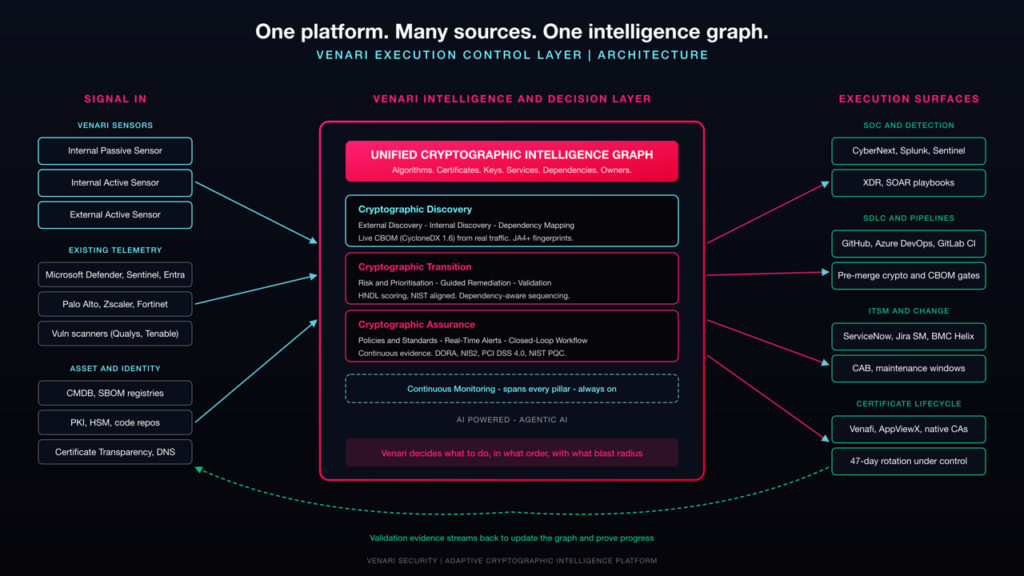
SOC platforms
Splunk, Sentinel, Chronicle, and partner XDRs consume cryptographic events as first-class signal. Deprecated cipher suites in active use, weak certificate chains, JA4+ anomalies and HNDL-relevant flows surface inside the analyst’s existing console, not a parallel one.
SDLC pipelines
GitHub Actions, Azure DevOps, GitLab CI get pre-merge cryptographic checks, SBOM and CBOM gates, and build-time policy enforcement. New cryptographic debt cannot ship past a gated build.
ITSM and change management
ServiceNow, Jira Service Management, BMC Helix receive tickets pre-populated with the asset, the owner, the blast radius, the recommended action and the rollback plan. The customer’s existing CAB process governs approval. The execution layer does not bypass it.
PKI and certificate lifecycle
Venafi, AppViewX, cloud-native authorities operate against a continuously updated inventory. The CA/Browser Forum’s 200/100/47-day TLS validity reductions become manageable rather than catastrophic because the platform is already tracking authority, custody and renewal cadence asset by asset.
This is what we mean by governed cryptographic change. The intelligence and the decisioning live in the execution layer. The action lives in the customer’s existing fabric. The feedback loop closes when validation evidence flows back into the intelligence graph and updates the next decision.
How to sequence work by dependency and blast radius
The most common failure mode in a stalled PQC programme is the flat priority list. Everything quantum-vulnerable is marked critical, the queue is delivered to engineering, and the engineering response, reasonably, is to do nothing different.
Sequencing is the missing discipline. It is also the part of quantum migration execution that gets the least attention in vendor marketing, because it is harder to demo than a discovery scan.
Useful remediation sequencing answers four questions for every asset.
What kind of fix is this?
A vendor-patched product on a maintained version is a different proposition from a bespoke application embedding a vulnerable library, which is different again from a hardware appliance whose vendor has no PQC firmware on the roadmap. Each path has different lead times, different change windows and different blocking dependencies.
What does it depend on?
An internal CA whose root chains thousands of downstream certificates cannot be rotated last; it has to be rotated first, or the dependents have nowhere to anchor. A shared cryptographic library used by twenty services cannot be patched per-service; it has to be moved at the library level. The dependency graph is the sequencing logic. Without it, the list cannot be ordered.
What is the blast radius if this change fails?
A certificate on an internal monitoring agent is not the same risk class as the certificate fronting the customer-facing payment gateway. The execution layer needs to score blast radius per asset, joined to business service and customer-impact tier, so the change calendar reflects reality and not just inventory order.
What is the regulatory deadline pressure?
PCI DSS 12.3.3 and 4.2.1.1 are mandatory now. DORA's cryptographic obligations applied from 17 January 2025. NIS2 implementation is in flight across Member States. The NCSC's 2028 milestone is inside most boards' planning horizons. Where a finding maps to a named obligation with a near-dated deadline, that pressure has to enter the queue order.
Put together, these four answers produce a dependency-aware remediation plan: an ordered programme of work, mapped onto the operational reality of who owns each asset, what changes it needs, what depends on it, and what breaks if the change fails.
This is the cryptographic transition plan that NCSC’s three-phase model contemplates, expressed as an operational queue rather than a strategy document.
The sequencing has to be live. New assets appear – a forgotten subdomain, a cloud workload spun up by an acquired business unit. Vendor patches land. Hardware refresh cycles change. The migration control plan that was correct in Q1 will be wrong by Q3 if it is not continuously reconciled against the estate. That is the closed loop: discovery feeds the graph, the graph feeds prioritisation, prioritisation feeds the gated execution surfaces, and validation evidence flows back into the graph.
How to prove progress without causing outages
Two pressures sit on every CISO running a PQC programme, and they pull in opposite directions.
- – The first is the regulatory and board pressure to show measurable progress. Activity is no longer enough. NCSC’s timelines, NIST IR 8547’s deprecation horizon, DORA’s continuous risk-management obligations and the emerging NIS2 implementation guidance all point in the same direction: regulators want to see resolved risk, with evidence, on a cadence that does not look like an annual exercise.
- – The second is the operational pressure to not break anything. Cryptographic changes are uniquely high-stakes. A bad certificate rotation takes an authentication service offline. A bad library upgrade breaks an entire service mesh. A bad cipher suite policy locks out legitimate clients. The instinct in most security and platform teams, correctly, is to move carefully.
The execution layer has to satisfy both pressures simultaneously, and the way it does that is by routing every change through the customer’s existing controls while producing the validation evidence the regulator needs as a by-product of the work.
Three operational habits make this workable.
- – First, every change carries its rollback plan from the moment the ticket is created. The ITSM ticket that lands in ServiceNow or Jira already names the asset, the owner, the recommended action, the dependencies, the maintenance window and the back-out procedure. The change manager is not being asked to invent the change plan. They are being asked to approve a pre-staged one. That is what makes the CAB say yes.
- – Second, validation is operational, not declarative. “We patched the library” is not validation. “The library version observed in production traffic is now the patched version, the deprecated suite has not been negotiated by any client in the last 48 hours, and the live CBOM reflects the new state” is validation. The execution layer has to confirm change at the protocol level, not at the ticket level, because tickets close optimistically and protocols do not.
- – Third, evidence is continuous and signed. The regulator’s eventual question is not “did you migrate?” but “show me the state of cryptographic risk in your estate, with attestation, on a date of my choosing.” The execution layer produces that as a stream exportable, time stamped, tied back to the named obligation rather than as a slide deck prepared the week before the audit. This is what validation evidence actually means in practice: an artefact the platform emits because of how it runs, not because someone wrote a report.
The shift this enables is significant. Discovery, on its own, becomes static reporting that ages on the day it ships. Discovery wrapped in an execution layer becomes continuous control. The same data, two operating models, very different outcomes. One produces a binder of findings, a stalled programme and a nervous CISO. The other produces a live programme, a defensible audit posture and a calm one.
The shift
Most post-quantum programmes are not failing because the cryptography is hard, the standards are unclear, or the budget is short.
They are failing because the operating model between “we found it” and “we fixed it” does not exist yet.
Building that layer is not a moonshot. The execution surfaces – SOC, SDLC, ITSM, PKI – already exist in every enterprise that runs at scale. The cryptographic intelligence to drive them is increasingly available. What was missing was the layer that turns that intelligence into prioritised, governed, validated change without ripping out anything the customer already paid for.
That is the work. Sequence by dependency and blast radius. Gate every change through the systems that already run the business. Validate operationally, not declaratively. Emit evidence continuously, signed, exportable, and mapped to the obligation it satisfies.
Discovery is the floor. The execution layer is the operating model. The programmes that ship against the 2028, 2031 and 2035 horizons will be the ones that built the second thing on top of the first.
Book your PQC Readiness Assessment
Understand your exposure to quantum threats and build a clear, prioritised migration strategy.

Related Content

A Practical Roadmap to Quantum-Safe Cryptography for UK/EU Enterprises
Key Takeaways Timeline: Start now-3-5 year migration timelines mean immediate action required For: CISOs, IT Directors, Security Architects,…

NCSC Guidance on Post-Quantum Cryptography (PQC) What UK and EU Organisations Need to Know Now
Key Takeaways Timeline: NCSC three-phase roadmap (2028, 2031, 2035 deadlines) for UK/EU PQC standards migration For: CISOs, IT…

Expert Perspectives
Leading PQC experts share insights on enterprise encryption across a series of video discussions featuring senior security leaders…